
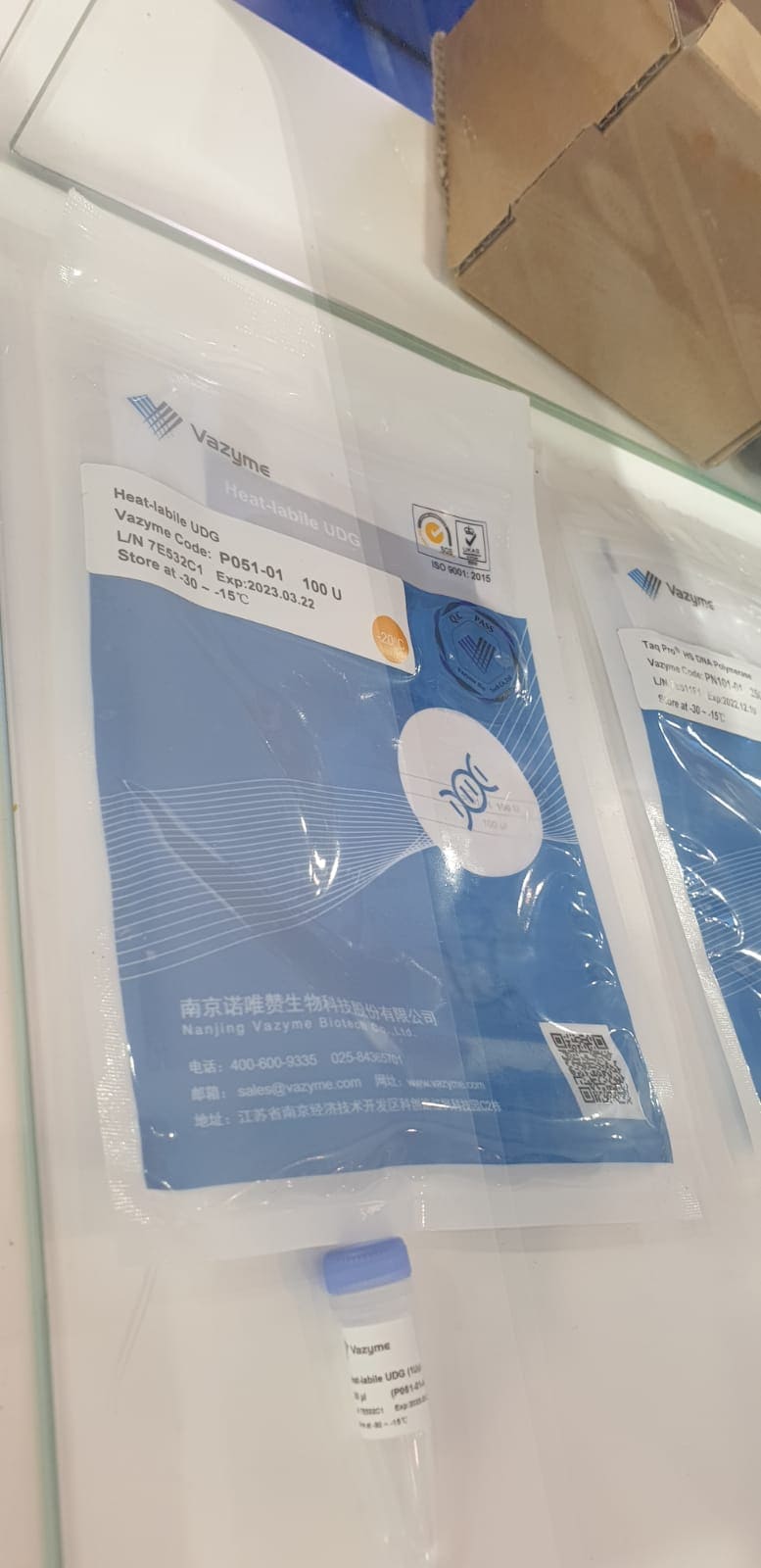
Properties
Quality level: 100
Form: solution
Packaging
100 U pack (11775367001)
500U pack (11775375001)
Optimum pH: 8.3-8.9
Sent in: dry ice
Storage temperature: −20 ° C
General description
Thermolabile Uracil-DNA Glycosylase contains the also named enzyme found in the marine bacterium BMTU 3346. Like UNG from E. coli, it hydrolyzes uracil-glycosidic bonds in single or double-stranded DNA, cleaving uracil and creating sensitivity to alkalis. basic sites in DNA. These basic sites can be hydrolyzed by treatment with endonucleases, heat, or alkali. Depending on how the DNA is prepared, uracil-DNA glycosylase can be used to achieve general, site-specific, or chain-specific cleavage. This enzyme shows a lower thermostability and is, therefore, easier to inactivate.
Characteristics of the enzyme
The BMTU 3346 enzyme is inactivated faster (2 minutes at + 95 ° C) than the corresponding enzyme from E. coli (10 minutes at + 95 ° C). E. coli UNG has also been reported to remain partially active, leading to degradation of the dU-containing PCR product. In contrast, thermolabile UNG does not degrade dU-PCR products in at least several hours of incubation between +2 and +8 ° C. Therefore, it is not necessary to freeze the PCR product immediately after amplification or to keep the reaction mixture at -70 ° C.
Specificity
- Uracil-DNA glycosylase hydrolyzes the uracil-glycosidic bonds at the U-DNA sites in single and double-stranded DNA, cleaving uracil and creating alkali-sensitive abasic sites in DNA.
- The enzyme is active in both single-stranded and double-stranded DNA.
- Uracil-DNA glycosylase is inactive in native uracil-free RNA and DNA.
- Since uracil-DNA glycosylase has no metal ion requirements, it is fully active in the presence of EDTA.
Heat inactivation: 95 ° C for 2 min
Application
Uracil-DNA glycosylase can be used to cleave DNA at any site where a deoxyuridylate residue has been incorporated. Due to the thermolability of uracil-DNA glycosylase, the main application of this thermolabile enzyme is the prevention of carryover contamination in PCR. In contrast to the enzyme from E. coli; With this UNG preparation, it is not necessary to freeze the PCR product immediately after amplification or to keep the reaction mix at +70 ° C.
Important note: For highly sensitive techniques such as real-time PCR, we recommend our LightCycler® Uracil-DNA Glycosylase which is optimized for this application.
Features and Benefits
- Avoid carryover contamination in PCR.
- Increase the efficiency of site-directed mutagenesis procedures.
- Label the oligonucleotide probes.
- Perform a faster inactivation than the corresponding E. coli enzyme due to the lower thermostability of the enzyme.
- Do not obtain degradation of the dU-PCR products within at least several hours of incubation at +2 to + 8 ° C.
Content
The enzyme is supplied as a 1 U / μl solution in a storage buffer.
Quality
Function test: carryover prevention activity is assessed by adding approximately 105 dU containing templates prior to the amplification reaction. After UNG treatment, no amplification products could be detected. The enzyme does not contain contaminating Exo or endonucleases and is free of RNase activity, according to current quality control procedures.
Definition of unit
One unit is defined as the amount of uracil-DNA glycosylase required to completely degrade 1 μg of purified uracil-containing single-stranded DNA (bacteriophage M13, grown in E. coli CJ236 dut-ung-) at +37 ° C in 60 minutes.
One Lindahl unit is defined as the amount of enzyme required to release 1 mole of uracil at +37 ° C in 1 minute. A Lindahl unit is comparable to 520,000 units by our definition of a unit.
Volume activity: 1 U / μl
Other notes
For general laboratory use.
Legal information
LightCycler is a registered trademark of Roche